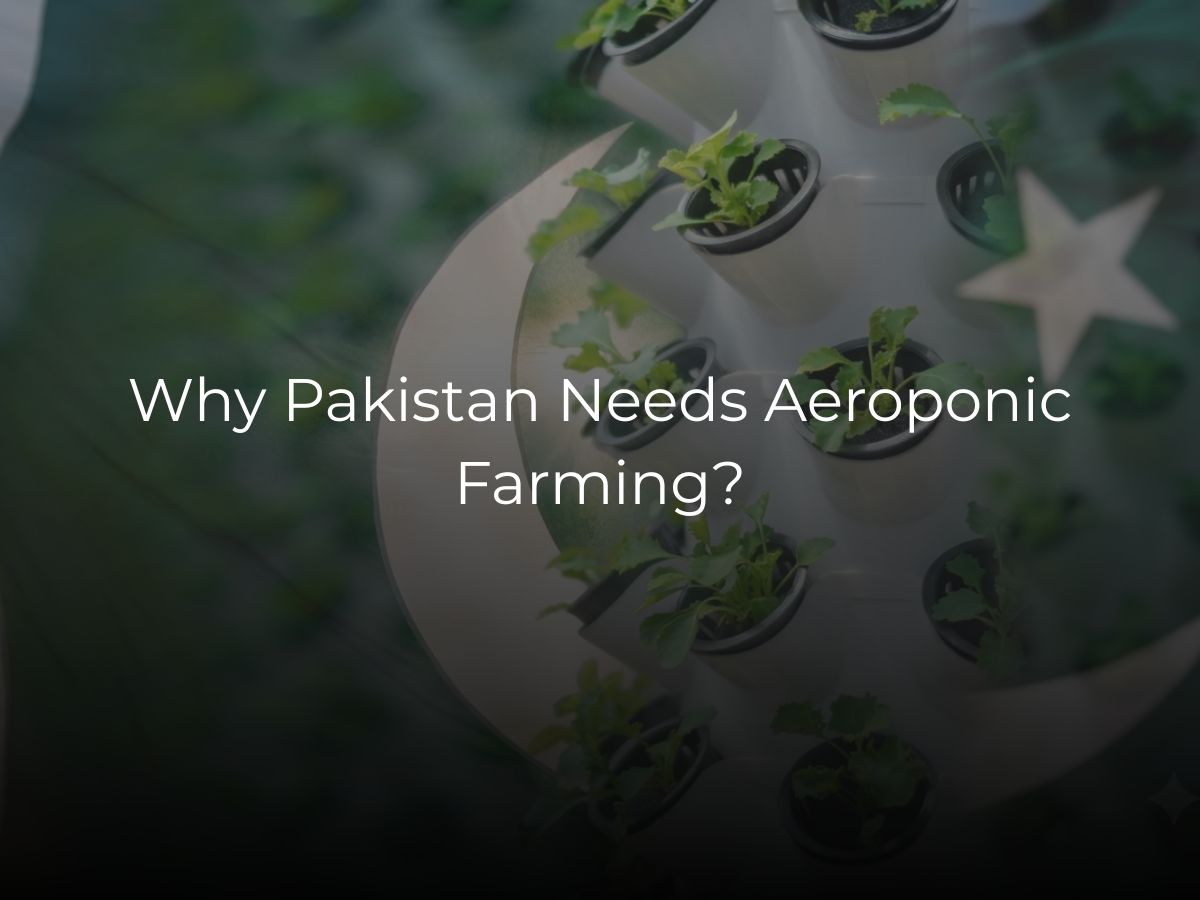
Why Pakistan Needs Aeroponic Farming: Can It Help Solve the Country’s Growing Agricultural Challenges?
Why Pakistan Needs Aeroponic Farming: Can It Help Solve the Country’s Growing Agricultural Challenges?
Pakistan has always been an agricultural nation, but farming is becoming more challenging. Rising temperatures, water scarcity, unpredictable monsoon rains, and devastating floods are making it harder for farmers to produce crops consistently. At the same time, a growing population is increasing the demand for fresh, high-quality food.
Traditional farming remains the backbone of Pakistan’s agriculture and will continue to play that role for generations. However, these changing conditions highlight the need to explore additional farming methods that can improve resource efficiency and strengthen food production.
One such method is aeroponic farming. By growing plants without soil and delivering water and nutrients directly to their roots, aeroponic systems can use significantly less water while providing growers with greater control over the growing environment. Research suggests that this technology can support more sustainable food production, particularly in regions facing climate and water-related challenges. (Interlink “research suggests” or “aeroponic systems” to the 2026 MDPI review.)
In this article, we’ll explore the key agricultural challenges facing Pakistan and examine how aeroponic farming can become part of the solution.
Pakistan’s Agriculture Is Facing New Challenges
Agriculture has always depended on nature, but today’s climate is becoming increasingly unpredictable.
In recent years, Pakistan has experienced record-breaking heatwaves, prolonged dry spells, irregular monsoon rains, and severe flooding. These events don’t just affect crop yields. They also influence water availability, soil health, planting schedules, and farmers’ livelihoods. Researchers studying vulnerable farming communities in Punjab found that climate variability is already changing how farmers plan their growing seasons and manage their crops.
As these challenges continue to grow, improving agricultural resilience has become just as important as increasing production.
Challenge 1: Water Scarcity Is Putting Pressure on Agriculture
Water is one of Pakistan’s most valuable agricultural resources, yet it is becoming increasingly difficult to manage efficiently.
Agriculture consumes the majority of the country’s freshwater resources, making reliable water availability essential for food production. However, rising temperatures, changing rainfall patterns, groundwater depletion, and recurring droughts are placing additional pressure on irrigation systems. Studies from Pakistan’s Indus Basin have also highlighted growing concerns about groundwater sustainability under changing climate conditions.
This is where aeroponic farming offers an important advantage.
Unlike conventional irrigation methods, aeroponic systems deliver a fine nutrient mist directly to plant roots while continuously recirculating unused water. Because very little water is lost through runoff or evaporation, these systems can dramatically improve water-use efficiency.
A recent review published in the journal Agriculture reported that well-managed aeroponic systems can reduce water consumption by more than 90% compared with conventional farming, depending on the crop and growing conditions. Rather than replacing traditional farming, this makes aeroponics a valuable option for producing certain high-value crops in water-stressed regions.
At Spurt Nova, we’ve seen how efficient water management becomes possible when every drop is monitored and reused. While aeroponics isn’t the answer for every crop, it demonstrates how modern farming technologies can help conserve one of Pakistan’s most precious natural resources.
Challenge 2: Climate Change Is Making Farming Less Predictable
Climate change is no longer a future concern for Pakistan. It’s already affecting how, when, and where crops are grown.
Over the past few years, farmers have had to cope with intense heatwaves, changing rainfall patterns, and longer dry periods. These changing weather conditions can affect crop growth, reduce yields, and increase the demand for irrigation water. Research also suggests that rising temperatures may shorten the growing period of some crops, making it more difficult for farmers to maintain consistent production.
While no farming system can eliminate the effects of climate change, controlled-environment agriculture offers an opportunity to reduce dependence on unpredictable weather. Because aeroponic systems are operated in controlled conditions, growers can regulate factors such as temperature, humidity, irrigation, and nutrient delivery. This creates a more stable environment for crops, regardless of what’s happening outside.
At Spurt Nova, we’ve seen how maintaining a controlled growing environment helps protect crops from sudden weather changes. It’s one of the reasons aeroponics is gaining attention as agriculture adapts to a changing climate.
Challenge 3: Floods and Unpredictable Monsoon Rains
Pakistan’s monsoon season is becoming increasingly unpredictable, creating serious challenges for farmers.
Some years bring below-average rainfall, while others bring devastating floods that destroy crops, damage farmland, and delay planting for the next season. The 2022 floods were a stark reminder of how vulnerable agriculture can be to extreme weather. Satellite-based research found that millions of hectares of agricultural land were affected, leading to significant losses in crops such as cotton, rice, and sugarcane.
Aeroponic farming cannot prevent floods, but it can reduce a farm’s exposure to them. Since crops are grown in controlled environments rather than directly in open fields, they’re less vulnerable to heavy rainfall, waterlogging, and soil erosion. This makes aeroponics a practical option for producing certain high-value crops, even when outdoor farming conditions become challenging.
Rather than replacing traditional agriculture, controlled-environment farming can strengthen the overall food production system by adding another layer of resilience.
Challenge 4: Feeding a Growing Population with Limited Resources
Pakistan’s population continues to grow, increasing the demand for fresh, high-quality food while natural resources become more limited.
Meeting this demand isn’t simply about producing more food. It’s about producing food more efficiently.
Aeroponic farming allows growers to cultivate crops vertically, making better use of available space while using significantly less water than conventional irrigation methods. This makes it particularly suitable for leafy greens, herbs, and other high-value crops that benefit from controlled growing conditions.
Research on controlled-environment agriculture highlights that technologies such as aeroponics can improve resource efficiency while supporting year-round production, reducing dependence on seasonal weather patterns.
For countries like Pakistan, where urban areas continue to expand and agricultural resources face increasing pressure, these technologies offer an opportunity to supplement existing farming systems rather than replace them.
Challenge 5: Making Better Use of Agricultural Land
Farmland is a valuable resource, and using it efficiently is becoming increasingly important.
Urban expansion, industrial development, and environmental pressures are reducing the amount of land available for agriculture in many parts of the world. At the same time, farmers are expected to produce more food for a growing population.
Aeroponic farming addresses this challenge by growing crops vertically in controlled environments. Instead of relying on large areas of fertile land, multiple layers of crops can be cultivated within a relatively small footprint. This makes efficient use of available space while maintaining consistent growing conditions.
It’s important to note that aeroponics isn’t suitable for every crop. Staple crops such as wheat and rice will continue to rely primarily on conventional farming. However, for crops like lettuce, herbs, and strawberries, aeroponics provides an efficient alternative that can complement traditional agriculture.
Why Aeroponics Can Be Part of Pakistan’s Future
Pakistan’s agricultural future doesn’t depend on choosing one farming method over another. It depends on adopting the right solution for the right challenge.
Traditional farming will continue to play a central role in feeding the nation. At the same time, technologies like aeroponics can help address specific issues such as water scarcity, climate resilience, and efficient land use.
As research into controlled-environment agriculture continues to grow, aeroponics is increasingly being recognised as a valuable tool for sustainable food production, particularly in regions facing environmental pressures.
What We’ve Learned at Spurt Nova
At Spurt Nova, we don’t see aeroponics as a replacement for Pakistan’s farming traditions. We see it as an opportunity to build on them.
Every visitor who walks through our farm asks thoughtful questions about how plants grow without soil, how nutrients are delivered, and whether this technology can really work in Pakistan. Those conversations remind us that innovation begins with understanding.
Our experience has shown us that when people see healthy crops growing in a controlled environment, many of their doubts are replaced with curiosity. That’s why we’re committed not only to growing fresh produce but also to helping more people understand how modern farming technologies can support Pakistan’s agricultural future.
Conclusion
Pakistan’s agriculture is facing new realities. Water scarcity, climate change, unpredictable monsoon rains, floods, and growing food demand are creating challenges that require practical and innovative solutions. While traditional farming will always remain the backbone of the country’s food production, it can be strengthened by technologies that improve resource efficiency and resilience.
Aeroponic farming is one such solution. By using significantly less water, reducing dependence on changing weather conditions, and making efficient use of space, it offers a promising way to grow certain crops sustainably. It isn’t designed to replace conventional farming, but to complement it where it makes the most sense.
At Spurt Nova, we’re proud to be pioneering aeroponic farming in Pakistan and demonstrating how innovation and traditional agriculture can work together. We believe that by embracing both experience and technology, Pakistan can build a stronger, more sustainable future for generations to come.