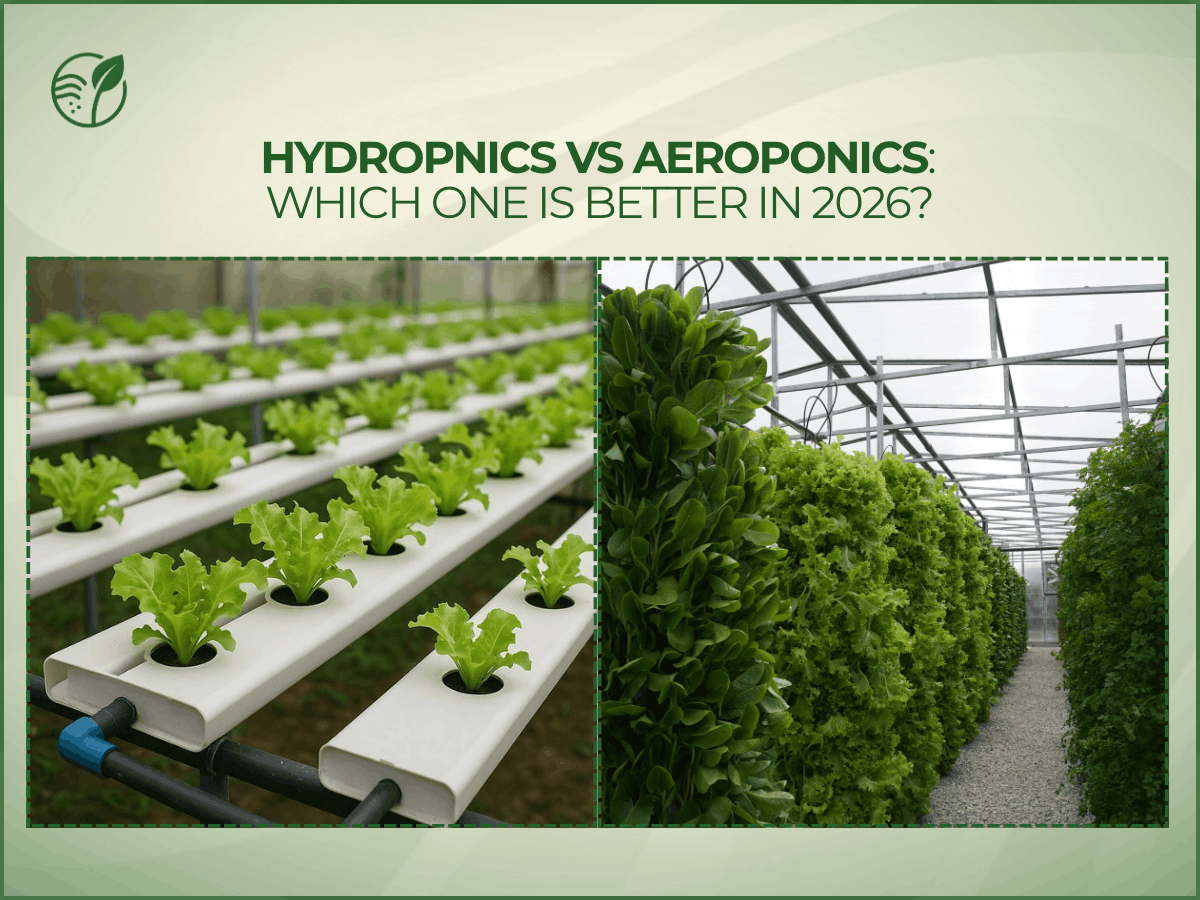
Hydroponics vs Aeroponics: Which One is Better in 2026?
Aeroponics and hydroponics are two of the most popular soilless farming methods, but they’re often confused with one another. While both allow plants to grow without soil, they differ in how water, nutrients, and oxygen are delivered to the roots.
Both systems are more water-efficient than traditional farming and can produce high-quality crops. However, they vary in terms of water usage, setup costs, maintenance, crop performance, and overall efficiency.
In this article, we’ll compare aeroponics and hydroponics side by side, explore what scientific research says about each method, and help you understand which system is better suited for different growing needs.
What Is Aeroponics?
Aeroponics is a soilless farming method where plant roots are suspended in the air and regularly sprayed with a nutrient-rich mist.
Instead of growing in soil or being submerged in water, the roots receive water, oxygen, and essential nutrients through fine misting nozzles. This provides excellent root aeration while allowing growers to precisely control nutrient delivery.
Because the roots have constant access to oxygen, aeroponic systems are often associated with faster root development, efficient nutrient uptake, and significantly lower water consumption. Research published in the journal Agriculture highlights aeroponics as one of the most resource-efficient forms of controlled-environment agriculture, particularly for leafy greens, herbs, and other high-value crops.
At Spurt Nova, this is the technology we’ve chosen because it combines efficient water use with precise environmental control, making it well suited for producing fresh, high-quality crops in Pakistan.
What Is Hydroponics?
Hydroponics is a soilless farming method where plant roots grow in a nutrient-rich water solution instead of soil.
Depending on the type of hydroponic system, roots may remain partially or fully submerged in water, or they may be supported by an inert growing medium such as coco coir, perlite, or rockwool. The nutrient solution continuously supplies the minerals plants need for healthy growth.
Hydroponics has been used commercially for decades and is widely recognised for its reliability, relatively simple operation, and ability to produce consistent crop yields. Compared with aeroponics, hydroponic systems are generally easier to install and maintain, making them a popular choice for beginners and commercial growers alike.
Like aeroponics, hydroponics allows growers to monitor nutrients, irrigation, and environmental conditions more precisely than conventional farming.
Aeroponics vs Hydroponics: At a Glance
| Feature | Aeroponics | Hydroponics |
|---|---|---|
| Growing Method | Roots are suspended in air and misted with nutrients | Roots grow in a nutrient-rich water solution |
| Water Usage | Very low | Low |
| Root Oxygenation | Excellent | Good |
| Growth Rate | Often faster for certain crops | Fast and consistent |
| Initial Cost | Higher | Lower |
| Maintenance | More technical | Easier to manage |
| Suitable for Beginners | Moderate | Yes |
| Best For | Leafy greens, herbs, strawberries, seed potatoes | Leafy greens, tomatoes, cucumbers, peppers, herbs |
Both systems have proven to be effective for controlled-environment agriculture. The choice depends on your growing objectives, budget, and technical expertise.
Water Usage: Which System Is More Efficient?
Winner: Aeroponics
If water conservation is your top priority, current research consistently gives aeroponics the advantage.
Unlike hydroponics, where plant roots remain in a circulating nutrient solution, aeroponic systems deliver nutrients as a fine mist directly to the roots. Any unused solution is typically collected and recirculated, reducing water loss through evaporation and runoff.
A comprehensive 2026 review published in the journal Agriculture found that well-managed aeroponic systems can reduce water consumption by more than 90% compared with conventional farming while also using less water than many hydroponic systems.
Hydroponics is also highly water-efficient and uses considerably less water than traditional irrigation. However, because plant roots remain in a larger volume of nutrient solution, overall water consumption is generally higher than in aeroponic systems.
For regions like Pakistan, where water scarcity is becoming an increasing concern, this difference can be particularly important.
Verdict: If your goal is to maximise water-use efficiency, aeroponics has a clear advantage according to current scientific research.
Root Oxygenation: Which System Creates a Better Growing Environment?
Winner: Aeroponics
One of the biggest differences between aeroponics and hydroponics is how plant roots receive oxygen.
In hydroponic systems, roots grow in a nutrient-rich water solution. While the water is usually oxygenated using air pumps or circulation systems, the roots remain in constant contact with water.
In contrast, aeroponic systems keep the roots suspended in the air and spray them with a fine nutrient mist. This gives the roots direct access to oxygen while still supplying the water and nutrients needed for growth.
Research suggests that this higher level of root aeration can improve nutrient uptake and support faster root development. The 2026 review published in the journal Agriculture highlights enhanced root oxygenation as one of the key advantages of aeroponic farming.
Verdict: If maximum root oxygenation is the goal, aeroponics has the advantage.
Plant Growth and Yield: Which System Produces Better Results?
Winner: Aeroponics (for many crops)
Both aeroponics and hydroponics can produce healthy, high-quality crops. However, research indicates that aeroponic systems often achieve faster growth and higher yields for certain crops because the roots have better access to oxygen and nutrients.
For example, studies on leafy greens, herbs, and seed potatoes have shown that aeroponic systems can improve plant growth while using fewer resources. A review published in Agriculture also reports that aeroponics has demonstrated strong potential for increasing productivity under controlled growing conditions.
That said, hydroponics remains an excellent choice for commercial production and is widely used around the world because of its consistent performance and simpler operation.
Verdict: For crops that benefit from maximum root aeration, aeroponics often performs better, while hydroponics offers reliable and consistent results across a wide range of crops.
Nutrient Efficiency: Which System Makes Better Use of Nutrients?
Winner: Aeroponics
Both systems deliver nutrients directly to the roots, making them far more efficient than conventional soil farming. However, aeroponics provides greater precision because nutrients are applied as a fine mist exactly where the roots need them.
This targeted delivery reduces nutrient waste and allows growers to monitor and adjust nutrient levels throughout the growing cycle. According to the Lakhiar et al. (2018) review on aeroponic systems, efficient nutrient delivery is one of the major advantages of aeroponic farming.
Hydroponics is also highly efficient, but nutrient solutions are stored in larger reservoirs, which may require more frequent monitoring and replacement depending on the system.
Verdict: Both methods are highly efficient, but aeroponics offers more precise nutrient delivery with minimal waste.
Disease Risk: Which System Is Less Likely to Spread Plant Diseases?
Winner: Aeroponics
Because hydroponic systems share a common nutrient solution, waterborne diseases can spread more easily if pathogens enter the reservoir. Proper sanitation and regular monitoring greatly reduce this risk, but it’s still an important consideration.
Aeroponic systems use significantly less standing water, creating an environment that’s generally less favourable for many waterborne plant diseases. Research has shown that reducing prolonged root contact with water can lower the risk of certain root-related diseases when systems are properly maintained. (2026 review published in the journal Agriculture) to the MDPI paper.)
It’s important to note that neither system is disease-proof. Regular cleaning, water quality management, and proper maintenance are essential for both.
Verdict: Aeroponics generally has a lower risk of waterborne diseases, although both systems require good management practices to keep crops healthy.
Initial Cost: Which System Is More Affordable?
Winner: Hydroponics
If you’re just starting out, hydroponics is generally the more affordable option.
Most hydroponic systems require fewer components and are easier to install, making them suitable for home growers, schools, and small commercial farms. Aeroponic systems, on the other hand, rely on misting nozzles, high-pressure pumps, timers, and more precise controls, which increases the initial investment.
The 2026 review published in the journal Agriculture notes that while aeroponics offers significant resource-saving benefits, its higher setup cost remains one of the biggest barriers to wider adoption.
Verdict: If your budget is limited, hydroponics is usually the better choice.
Maintenance: Which System Is Easier to Manage?
Winner: Hydroponics
Hydroponic systems are generally easier to operate and maintain because they have fewer moving parts and are more forgiving if small issues arise.
Aeroponic systems require regular monitoring to ensure that pumps, timers, and misting nozzles continue to work properly. If the misting system stops for an extended period, plant roots can dry out more quickly than in hydroponic systems.
This doesn’t mean aeroponics is difficult, but it does require more attention and technical knowledge to achieve the best results.
Verdict: For beginners and growers looking for a simpler system, hydroponics has the advantage.
Best Crops for Each System
Neither system is ideal for every crop. The right choice depends on what you’re planning to grow.
Aeroponics is ideal for:
- Leafy greens (lettuce, spinach, kale)
- Fresh herbs (basil, mint, coriander)
- Strawberries
- Seed potatoes
- Plant propagation and research
- Cucumbers
Hydroponics is ideal for:
- Lettuce and leafy greens
- Tomatoes
- Peppers
- Herbs
- Many commercial greenhouse crops
Research shows that both systems can produce excellent results when matched with suitable crops and managed correctly.
Aeroponics vs Hydroponics: Quick Comparison
| Feature | Winner |
|---|---|
| Water Efficiency | ✅ Aeroponics |
| Root Oxygenation | ✅ Aeroponics |
| Growth Rate | ✅ Aeroponics (for many crops) |
| Nutrient Efficiency | ✅ Aeroponics |
| Disease Risk | ✅ Aeroponics |
| Initial Cost | ✅ Hydroponics |
| Ease of Maintenance | ✅ Hydroponics |
| Beginner Friendly | ✅ Hydroponics |
So, Which Farming Method Is Better?
The answer depends on your goals.
If you’re looking for a system that’s affordable, easy to manage, and well suited for beginners, hydroponics is an excellent choice. It’s a proven technology that’s widely used around the world for commercial crop production.
However, if your priority is maximum water efficiency, precise nutrient delivery, improved root oxygenation, and advanced controlled-environment farming, current research suggests that aeroponics offers several important advantages. Studies have consistently highlighted its ability to reduce water consumption, improve resource efficiency, and support strong crop performance under well-managed conditions.
Rather than viewing the two systems as competitors, it’s more accurate to see them as technologies designed for different needs. Many commercial growers even use both, depending on the crops they’re producing.
Our Perspective at Spurt Nova
At Spurt Nova, we’ve chosen aeroponic farming because it aligns with our vision of producing fresh, high-quality crops while using water and nutrients more efficiently.
That doesn’t mean hydroponics isn’t effective. In fact, it has helped transform modern agriculture and continues to be an excellent solution for many growers. We simply believe that, for Pakistan’s growing challenges around water scarcity and sustainable farming, aeroponics offers unique advantages worth exploring.
Every day, we see visitors surprised by how healthy plants can grow without soil. Once they understand the science behind aeroponics and witness it in action, many realise that innovation and sustainability can go hand in hand.
Conclusion
Both aeroponics and hydroponics have changed the way we think about farming. By eliminating the need for soil and giving growers greater control over water and nutrients, both systems offer a more efficient approach to producing fresh food.
If you’re looking for a simple, cost-effective system, hydroponics is a practical and reliable option. But if your goal is to maximise water efficiency, optimise root health, and embrace the latest advancements in controlled-environment agriculture, aeroponics stands out as the stronger long-term solution for many high-value crops.
At Spurt Nova, we’re proud to be helping shape the future of aeroponic farming in Pakistan. Through innovation, education, and practical experience, we aim to demonstrate how modern farming technologies can work alongside traditional agriculture to build a more sustainable future.